Hubble II Space Telescope
The Dark ForestThe Hubble II Space Telescope is a second-generation observatory whose completion marks both a triumph of human engineering and the militarization of knowledge during the Trisolar Crisis. Enlarged from the original telescope’s 4.27-meter diameter to 21 meters, it increases observational capability fiftyfold. Its decisive significance emerges when its images reveal the wake of the approaching Trisolaran Fleet: the telescope cannot show the enemy planet itself, but it makes the fleet’s existence visible and confirms intelligence reports that reshape humanity’s understanding of the threat.
Design and Construction
The Hubble II Space Telescope uses compound-lens technology. Its lens components were manufactured on Earth and assembled in orbit, an arrangement that made the telescope too large to send into space in a single launch. Eleven launches were required, and the launch witnessed by Albert Ringier was the final one. The telescope was then nearing completion near the International Space Station, with its first deep-universe observations expected within two months.
The scale of the instrument reflects a new technological threshold. A 21-meter diameter gives Hubble II an observational power far beyond that of its predecessor, but the achievement depends on a complex chain of launches, orbital assembly, and international infrastructure. Its construction therefore belongs to the same historical movement as the space elevator, controlled fusion, spaceports, weapons research, and recirculating ecosystems: humanity is no longer merely looking toward space, but building the industrial foundations of a Solar System defense system.
Requisition and the Launch
The telescope’s final launch is observed from a public area beside an old countdown clock across a lake from the launch site. Ringier and the astronomers with him are denied access to the VIP platform because the object being launched does not belong to them, while uniformed generals are admitted by a NASA official. The exclusion gives the scene a sharp political outline: the scientists who created and understand the instrument are pushed to the margins as military authority claims priority.
Ringier nevertheless responds to the launch with unrestrained emotion, shouting, “It’s my Hubble!” The rocket’s ascent appears like an accelerated sunrise. Flames illuminate the lake with golden waves, redden half the sky after the vehicle passes through the clouds, and then vanish into the Florida night. The beauty of the spectacle is inseparable from its institutional violence. Ringier sees the telescope as a work of scientific culture; George Fitzroy, the military representative assigned after Hubble II’s requisition, sees it as equipment subject to wartime command.
Their argument makes the conflict explicit. Ringier calls the military a pack of thieves for taking “another thing of beauty,” while Fitzroy replies that wartime authority permits the requisition of civilian equipment and that the astronomers did not manufacture the lens components or design the screws. The exchange reduces ownership to competing definitions of contribution: scientific vision, industrial labor, and military necessity. Hubble II becomes visibly troublesome as an object rather than remaining transparent as a useful instrument, because its material existence exposes who controls advanced knowledge and who is allowed to claim its success.
Observation of the Trisolaran Fleet
A week after assembly is completed, Fitzroy and Ringier meet in Hubble II’s control room. Fitzroy demands an immediate observation of Trisolaris, but Ringier says that this is impossible because the telescope is already engaged in observations. Fitzroy suspects that the astronomers are conducting private work on the side, revealing the atmosphere of surveillance and distrust surrounding the instrument.
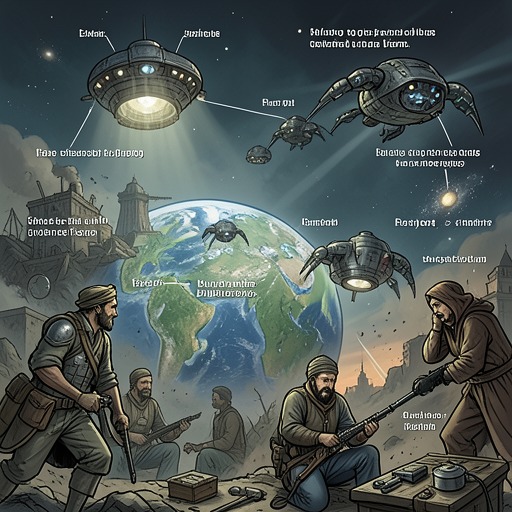
The telescope ultimately captures 210 images at multiple focal lengths. When the first image is processed, Ringier points to the screen and identifies the enemy world Fitzroy has wanted to see. Yet the image contains no recognizable planet. Fitzroy sees only three diffuse halos against a dark background, like streetlights viewed through fog. The three stars are not merely astronomical objects: they are the stellar system that will determine the fate of two civilizations.
The apparent failure becomes a greater discovery. Ringier explains that interstellar dust surrounds the three stars. Bodies moving at high speed have crossed the dust, leaving wakes through their impacts; those wakes have continued expanding until they reach a diameter twice that of Jupiter. At close range the wakes differ only subtly from the surrounding dust and cannot be detected. From a distance of four light-years, however, Hubble II can distinguish them. Fitzroy counts approximately a thousand bristles, and Ringier recognizes that number as confirmation of existing intelligence reports: humanity is looking at the Trisolaran Fleet.
The instrument therefore changes the status of the invasion. Before the observation, the fleet is an inference assembled from reports and theory. Afterward, its passage is materially inscribed in interstellar dust and registered through a sequence of images. Hubble II cannot provide the reassuring clarity of a visible planet or a close portrait of the enemy. Instead, its evidence is indirect, faint, and technically interpreted. The telescope makes the threat real precisely through what it cannot show.
Strategic and Historical Consequences
Hubble II’s discovery belongs to a broader transformation in which scientific instruments are absorbed into the defense of the Solar System. The space elevator and controlled fusion encourage humanity, but sober leaders recognize that these achievements are only the beginning. Building spacecraft, weapons, ecological life-support systems, and ports may require a century merely to establish the foundations. The telescope’s military requisition is thus not an isolated abuse: it is part of a civilization-wide redirection of resources toward survival.
That redirection carries severe costs. Constructing a space-defense system is expected to consume enough resources to reduce the quality of life by a century. The same industrial acceleration that supports the space forces also intensifies pollution, climate anomalies, desertification, and pressure on food production. Hubble II represents the knowledge needed to defend humanity, but its existence is embedded in the material system that makes defense environmentally destructive. The observatory’s achievement cannot be separated from the larger contradiction of the era: civilization seeks refuge beyond Earth while deepening the damage on Earth.
Hubble II also anticipates later attempts to turn planetary and stellar matter into defensive instruments. Exploration of Mars and the moons of Jupiter is organized primarily around bases for Solar System defense, while the strategic value of the inner planets leads to intensified exploration of Venus and Mercury. The proposed Mercury stellar hydrogen bomb test, the use of Neptune’s oil film to create dust for the Snow Project, and the gravitational-wave systems all extend the same logic: the Solar System becomes an engineered battlefield in which observation, energy, atmosphere, and celestial bodies are mobilized against the droplets and the Trisolaran threat.
Narrative and Thematic Significance
The telescope embodies the tension between vision and uncertainty. It is built to see farther and more powerfully than any previous human instrument, yet its crucial image appears only as three halos and a thousand barely distinguishable wakes. Scientific sight does not abolish ambiguity; it converts ambiguity into evidence through distance, comparison, and disciplined interpretation. Ringier’s explanation turns what looks like visual emptiness into the clearest confirmation humanity has received.
Its history also dramatizes the collapse of any simple opposition between civilian science and military technology. Ringier experiences Hubble II as beauty, authorship, and shared human accomplishment. Fitzroy treats it as requisitioned infrastructure whose value lies in strategic use. Neither perspective completely erases the other. The telescope remains a thing of beauty even after becoming military property, and it remains a weapon of knowledge even when its observers approach the universe with scientific curiosity.
Finally, Hubble II gives the approaching crisis a physical grammar. The Trisolaran Fleet is not introduced through spectacle at close range, but through traces in dust, spread across four light-years and visible only because an enormous human-made eye has been assembled in orbit. The fleet’s concealment and the telescope’s indirect revelation establish a recurring condition of the conflict: humanity must act on signs left by forces it cannot yet fully see. In that sense, Hubble II is not merely an observatory. It is the instrument through which the unknown becomes strategically undeniable.